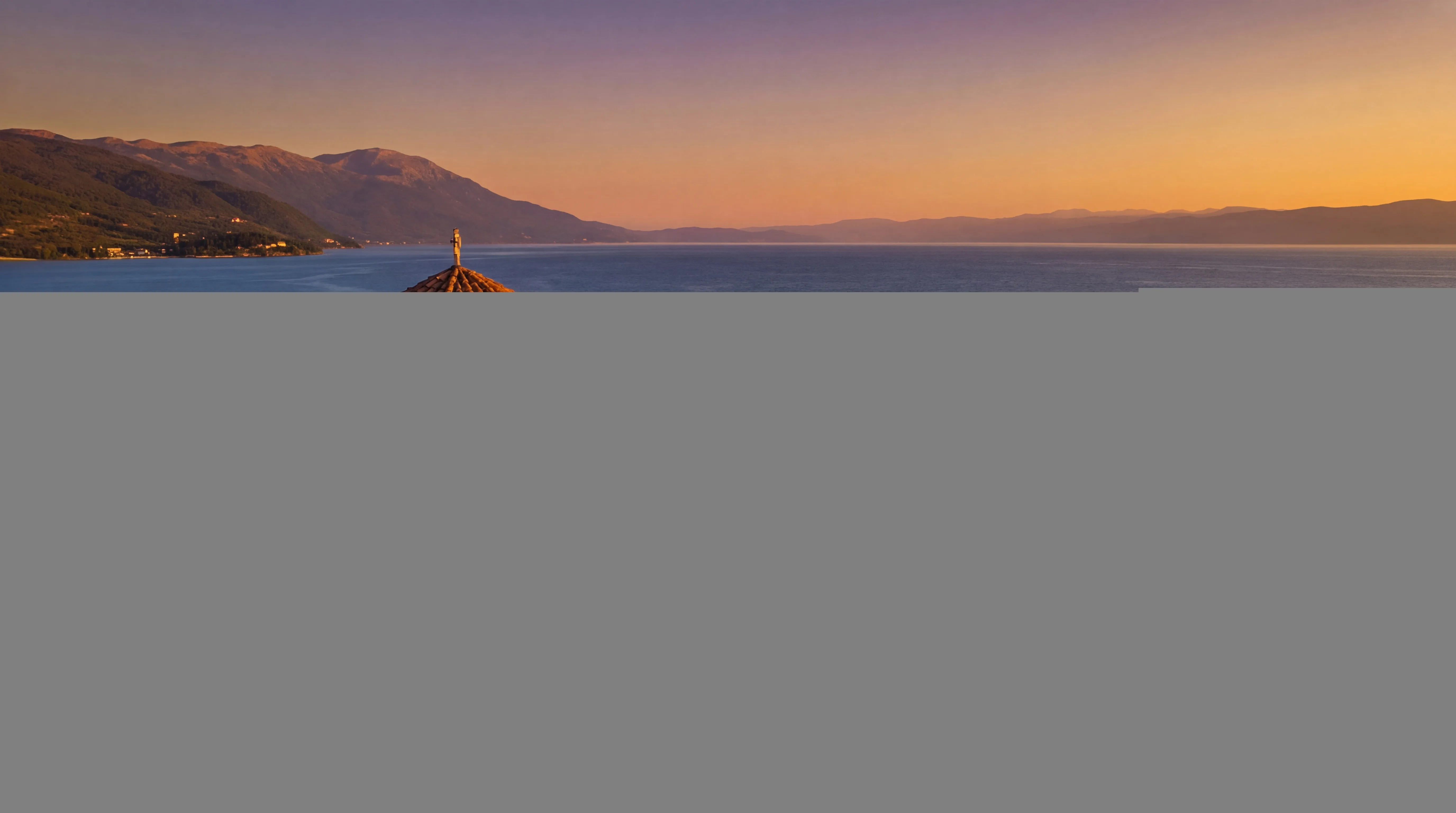
Lake Ohrid Loop
Lake Ohrid is between one and four million years old, depending on which geologist you ask, making it one of the oldest lakes in Europe and a place where the water has had time to figure things out. It is also, in less scientific terms, extraordinarily beautiful: 30 km long, up to 288 meters deep, and surrounded by mountains that turn the surface into a mirror on still mornings. The 90 km loop around the lake by car is the best single-day drive in North Macedonia – a circuit that passes through a medieval old town, an underwater archaeological museum, a monastery guarded by peacocks, and optionally crosses into Albania for a fish lunch in a village that most maps barely acknowledge.
We drove the loop clockwise from Ohrid, which gives you the Macedonian eastern shore in the morning (towns, churches, history) and the quieter western shore in the afternoon (monastery, lake views, optional Albania). The entire road is paved, the distances are short, and the only thing likely to slow you down is the scenery.
Route Overview
| Segment | Distance | Drive Time | Highlights |
|---|---|---|---|
| Ohrid old town (start) | – | – | Old town walk, Samuel’s Fortress, St. John at Kaneo |
| Ohrid to Bay of Bones | 20 km | 20 min | Lake shore road, museum on water |
| Bay of Bones to Sveti Naum | 10 km | 15 min | Monastery, springs, peacocks |
| Sveti Naum to Struga (via west shore) | 50 km | 50 min | Lake views, quiet villages |
| (Optional: Albanian detour via Lin) | +30 km | +45 min | Lin village, lake from Albanian side |
| Struga to Ohrid | 15 km | 15 min | Lakefront road, return |
| Total loop (without Albania) | ~90 km | ~2.5 hours driving | |
| Total loop (with Albania detour) | ~120 km | ~3.5 hours driving |
Ohrid Old Town
Start in Ohrid and give the town a proper morning before getting in the car. Ohrid’s old town climbs a hillside above the lake, and within its small area you will find more churches per square meter than almost anywhere in the Balkans. The town was the center of medieval Bulgarian and Slavic culture, and the Archbishopric of Ohrid once governed a religious territory stretching from the Adriatic to the Black Sea.
Park outside and walk in. The old town streets are narrow, cobblestoned, and increasingly pedestrian. Street parking near the lake is limited and regulated (MKD 30/hour / ~EUR 0.50 by SMS). Better options:
| Parking | Location | Cost | Notes |
|---|---|---|---|
| Biljanini Izvori | East of old town | MKD 50/day (~EUR 0.80) | Largest lot, easy access |
| Port area | Near the lake | MKD 30/hour (~EUR 0.50) | Closer, fills fast |
| Hotel parking | Various | Varies | If staying overnight |
What to See in Ohrid
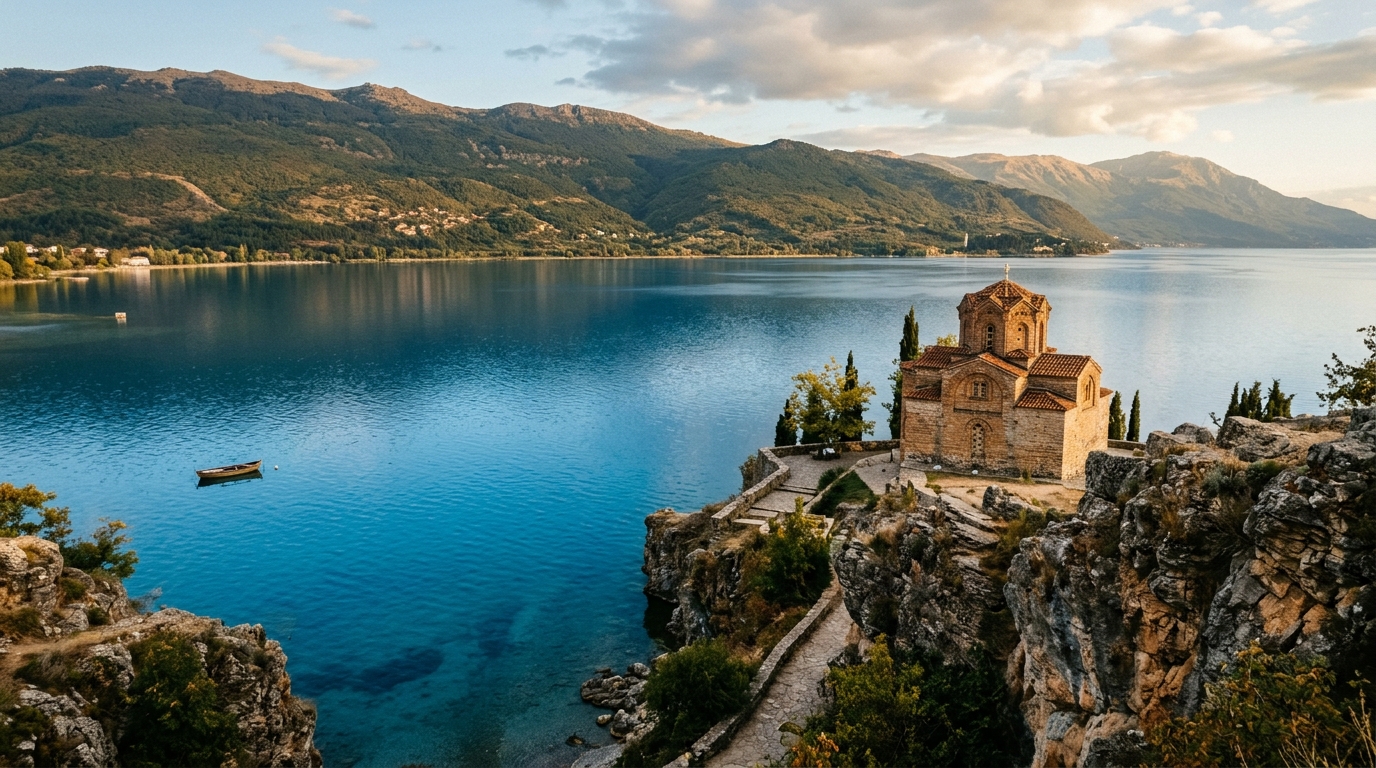
- Church of St. John at Kaneo: The postcard church, perched on a cliff directly above the lake. The walk from the old town takes 15 minutes along the lakefront path. The church itself is small (13th century) but the setting is perfect. This is where every photograph of Ohrid comes from.
- Samuel’s Fortress: The 10th-century fortress crowns the hilltop above the old town. Walls and towers are intact enough to walk along, and the views over the lake justify the uphill walk. Entry: MKD 60 (~EUR 1).
- Plaosnik (Church of St. Clement and St. Panteleimon): Near the fortress, this reconstructed church sits on the site of the first Slavic university, founded by St. Clement of Ohrid in 893. The archaeological remains and the church interior are worth 30 minutes.
- Old Bazaar: The lanes below the fortress have artisan shops, cafes, and the occasional Ottoman-era house. The Robevi House (now a museum) is a well-preserved example of Ohrid domestic architecture.
- Ancient Theatre: A Hellenistic theatre from the 3rd century BC, still used for summer performances. Free to visit when not hosting events.
Budget 2-3 hours for Ohrid’s old town. More if you want to swim at one of the lake platforms (free access from several points along the shoreline below the old town).
Tip: The walk from St. John at Kaneo along the cliff path to Plaosnik and then up to Samuel’s Fortress is the essential Ohrid experience. Do it in the morning when the light is on the lake and the tour groups have not yet arrived.
Bay of Bones
| Distance from Ohrid: 20 km south | Drive time: 20 minutes |
The Bay of Bones (Zalivot na Koskite) is an open-air museum built over the lake on wooden stilts – a reconstruction of a Bronze Age pile-dwelling settlement based on archaeological finds from the lake bed. The reconstruction is well done: a cluster of thatched wooden huts on platforms connected by walkways over the water, with exhibits on daily life in the settlement (tools, pottery, fishing implements).
The museum is small (30-45 minutes) but visually striking – the structures rising from the lake against the mountain backdrop make for good photographs. A short underwater viewing gallery shows some of the original pile foundations still embedded in the lake floor.
| Bay of Bones | |
|---|---|
| Entry fee | MKD 150 (~EUR 2.50) |
| Opening hours | 9:00-17:00 (extended in summer) |
| Time needed | 30-45 minutes |
| Parking | Free lot at the entrance |
A small beach next to the museum is one of the cleaner swimming spots on the lake – the water here is particularly clear due to underwater springs.
Sveti Naum Monastery
| Distance from Bay of Bones: 10 km | Drive time: 15 minutes |
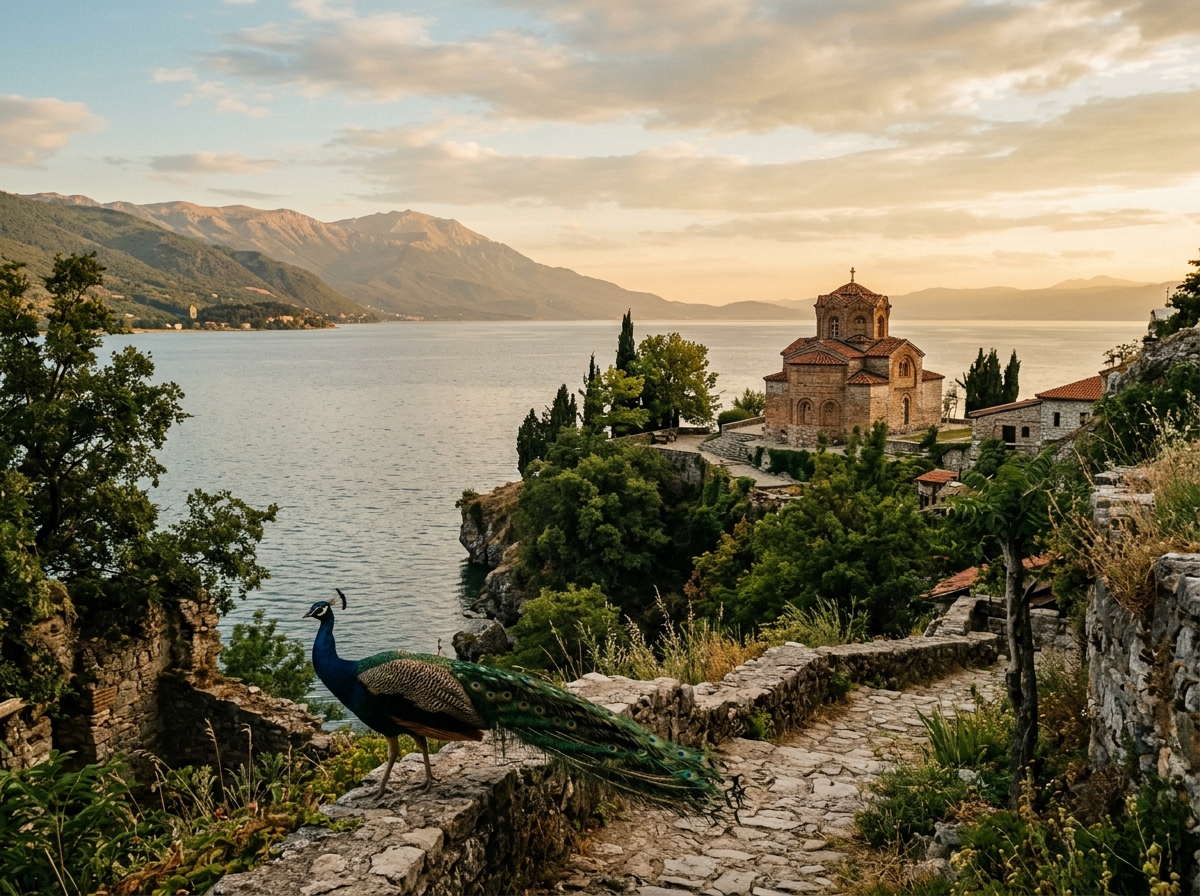
Sveti Naum is the second essential stop on the Ohrid loop, and it is one of those places where the combination of setting, history, and absurdity produces something memorable. The 10th-century monastery sits on a cliff above the lake at the southern end, about 1 km from the Albanian border. The complex includes a church with medieval frescoes, monastery buildings that now operate as a hotel, natural springs where the Crni Drim River originates, and peacocks.
The peacocks roam freely. They are descendants of birds brought here centuries ago, and they have the run of the grounds. They will display their feathers for photographs, steal food from your hand, and scream at dawn if you are staying in the monastery hotel. They are part of the experience.
| Sveti Naum | |
|---|---|
| Entry fee | Free (monastery grounds), MKD 100 (~EUR 1.60) for church interior |
| Parking | MKD 50 (~EUR 0.80) |
| Time needed | 1-1.5 hours |
| Boat ride on springs | MKD 200 (~EUR 3.30) for 20-minute ride |
| Restaurant | On-site, lake fish, moderate prices |
The springs at Sveti Naum are remarkable – clear water bubbling up from the lake bed into shallow pools that are almost impossibly turquoise. Small rowboats take visitors on a 20-minute tour of the springs (MKD 200 / ~EUR 3.30) – the water is so clear that the submerged vegetation and springs are visible at depth.
Lunch at Sveti Naum: The monastery restaurant serves fresh trout from the lake and traditional Macedonian dishes. Prices are moderate (a full meal runs MKD 400-600 / EUR 6.50-10). The terrace overlooks the lake.
The springs at Sveti Naum bubble up from underground with such clarity that the boats seem to float on air. This is not a metaphor – the water is genuinely invisible until the light catches it at the right angle.
Optional: Albanian Detour via Lin
From Sveti Naum, the Albanian border is 1 km south. If your car insurance covers Albania and you have your passport, a detour into Albania along the western shore of Lake Ohrid adds a different perspective and a genuinely interesting village.
The border crossing at Sveti Naum / Tushemisht is small and usually quick (5-15 minutes). From the Albanian side, drive south and then west along the lake shore to the village of Lin – a fishing village on a small peninsula that juts into the lake.
Lin is the kind of place that rewards those who make the effort. A hillside of stone houses overlooking the lake, a 5th-century early Christian basilica with well-preserved floor mosaics, and fish restaurants on the waterfront where a full meal costs EUR 5-8 per person. The village sees few foreign visitors, and the atmosphere is unhurried.
| Albanian Detour | |
|---|---|
| Border crossing | Sveti Naum / Tushemisht, usually 5-15 min |
| Distance (detour loop) | ~30 km |
| Time (with Lin stop) | 1.5-2 hours |
| Insurance | Check your Green Card covers Albania (or buy at border, ~EUR 15) |
| Currency | Albanian Lek (ALL), EUR accepted informally |
From Lin, continue north along the Albanian shore to Pogradec (a lakeside town with a busy market) and cross back into North Macedonia at the Cafasan / Sveti Naum border crossing or further north at the Tushemisht crossing.
Tip: The Albanian shore of Lake Ohrid is less developed than the Macedonian side, which is both its charm and its inconvenience. Roads are adequate but narrower, fuel stations are scarce (fill up in Pogradec if needed), and signage is minimal.
Struga
Returning to the Macedonian shore, the road runs north along the western edge of the lake to Struga, a town at the lake’s northern outlet where the Black Drim River begins its journey to the Adriatic.
Struga is smaller and quieter than Ohrid, with a lakefront promenade and a pleasant cafe scene along the river. The Struga Poetry Evenings (every August) are one of the oldest poetry festivals in the world, though you would not know this from the town’s modest self-promotion.
Stop for a coffee on the lakefront, walk the short pedestrian street, and then drive the final 15 km back to Ohrid along the northern lake road.
Practical Information
Road Conditions
The entire lake loop is paved and in good condition. The eastern shore road (Ohrid to Sveti Naum) is wider and better maintained. The western shore road (Sveti Naum to Struga, Macedonian side) is narrower in sections but perfectly manageable. On the Albanian side (if you take the detour), roads are adequate but narrower and less well-maintained.
A standard car handles the entire loop without issue.
Fuel
Fill up in Ohrid. Struga also has fuel stations. There are no fuel stations on the southern stretch between Ohrid and Sveti Naum (the distance is only 30 km, so this is not a range concern). If taking the Albanian detour, Pogradec has fuel stations.
Best Time
- May-June: Lake is filling from spring melt, water color at its most intense, comfortable temperatures, moderate tourist numbers.
- July-August: Hot (35+ degrees), Ohrid old town very busy, lakefront restaurants packed, parking challenging. Water is warmest for swimming.
- September-October: Our recommendation. Warm enough to swim, crowds gone, autumn light on the mountains. Many restaurants and hotels still open.
- Winter: The lake is beautiful in cold weather (never freezes), but tourist infrastructure is largely closed. Ohrid’s old town is atmospheric and nearly empty.
Accommodation
Ohrid is the obvious base with the widest selection:
| Type | Price Range (per night) | Notes |
|---|---|---|
| Hotels | MKD 2,500-6,000 (~EUR 40-100) | Center or lakefront |
| Apartments | MKD 1,500-3,000 (~EUR 25-50) | Best value, many on Booking.com |
| Monastery hotel (Sveti Naum) | MKD 3,000-4,500 (~EUR 50-75) | Unique experience, book ahead |
| Guesthouses (Struga) | MKD 1,200-2,500 (~EUR 20-40) | Cheaper alternative |
Combining with Other Routes
Lake Ohrid connects naturally with other North Macedonia drives:
- Skopje to Mavrovo: Drive from Ohrid to Mavrovo National Park (140 km, 2.5 hours) through the mountain interior, then continue to Skopje.
- Albania: From Ohrid, drive south through Albania to the Adriatic coast (Durres is 130 km, ~3 hours).
- Greece: The Greek border at Niki is 170 km southeast of Ohrid (3 hours), connecting to Thessaloniki.
For general driving information in North Macedonia – fuel costs, speed limits, insurance – see our Macedonia hub page and the driving guide.