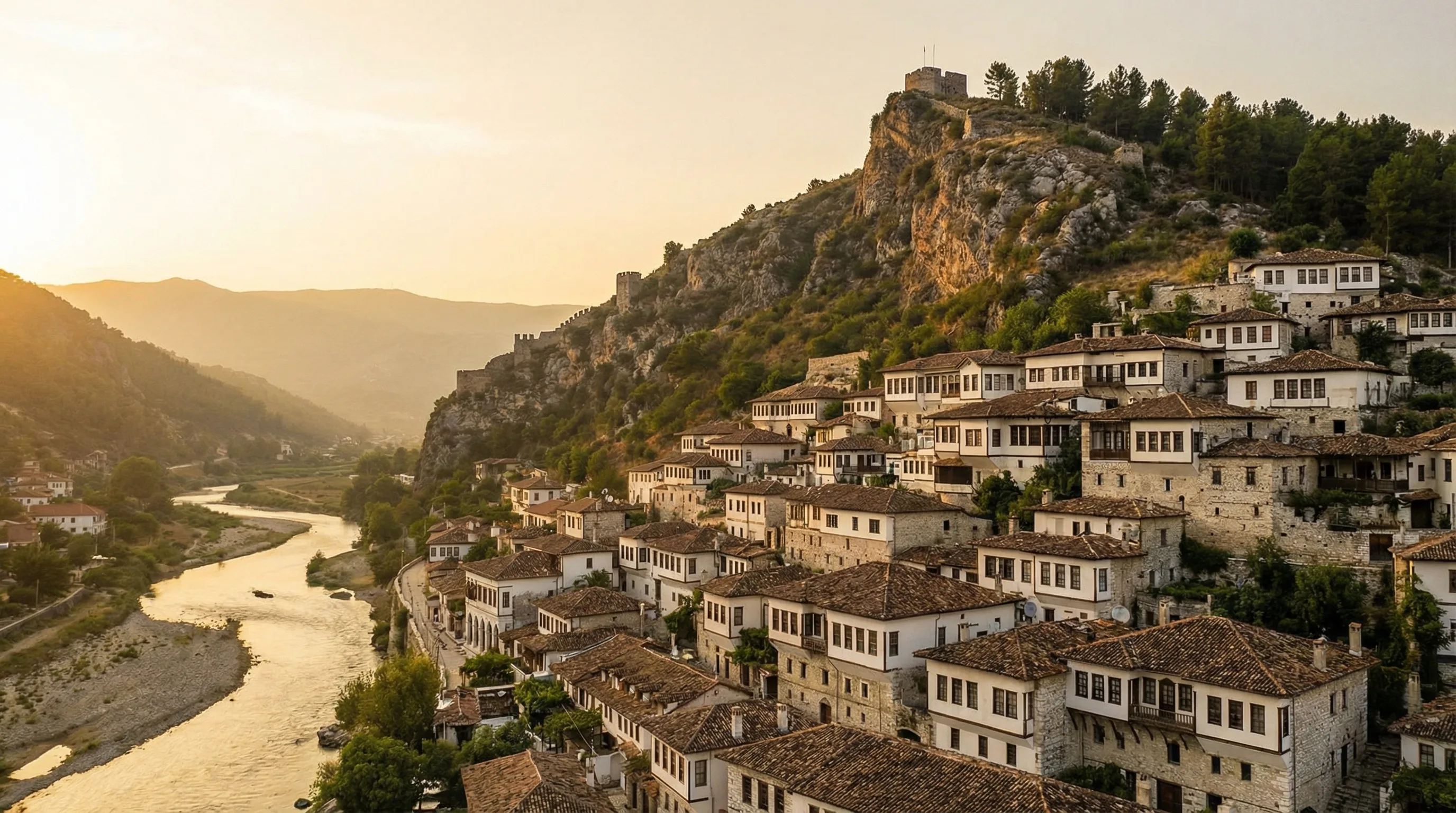
Albanian Riviera Driving Guide
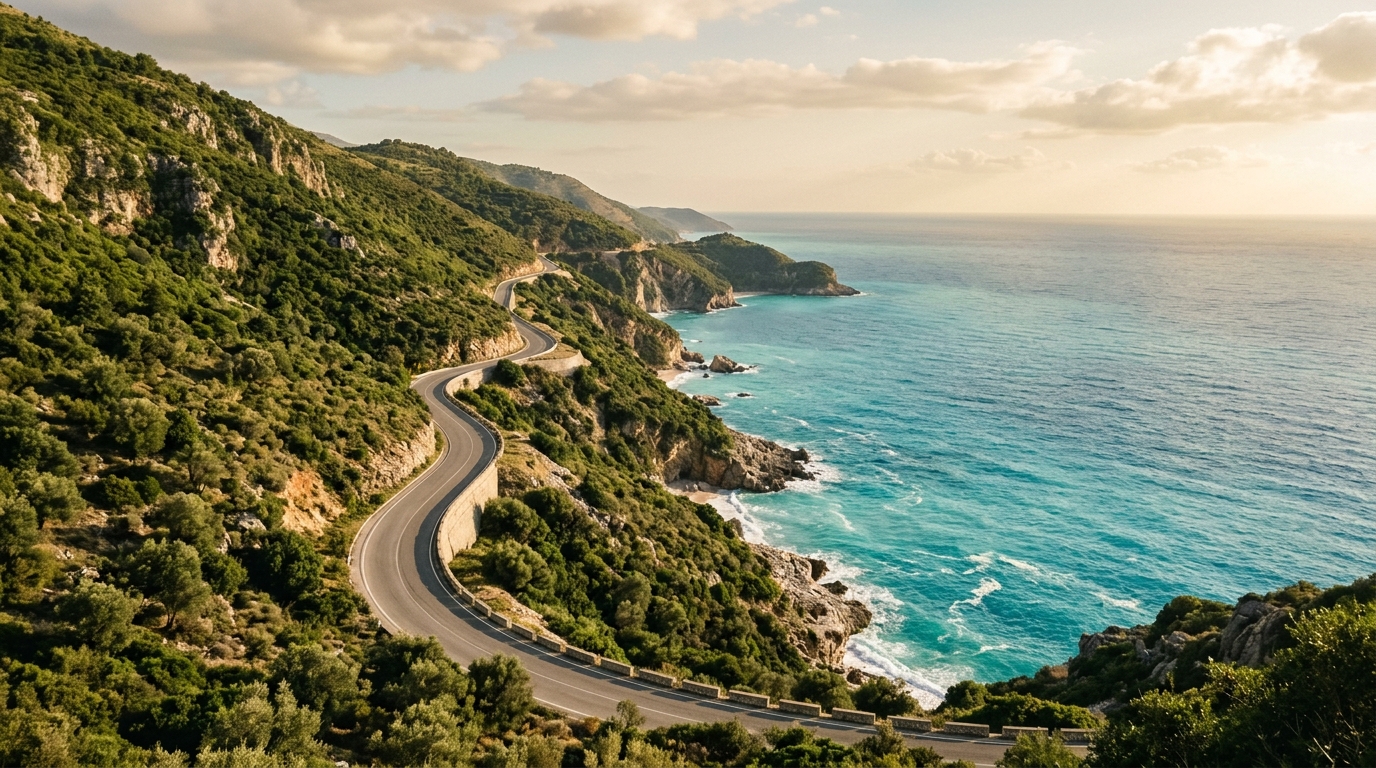
The SH8 from Vlora to Saranda is 130 km of coastal road that manages to be simultaneously one of the most beautiful drives in Europe and one of the most attention-demanding. We have driven it three times — once in a rented Fiat Punto that felt inadequate for the hairpin turns above Dhermi, once in a Toyota RAV4 that made the switchbacks almost comfortable, and once on a July afternoon when we shared the road with a flock of goats, two tour buses, and a man on a donkey who seemed entirely unconcerned about all of us. Each time, the Ionian Sea did something with light and color that made the white-knuckle sections worth it. The Albanian Riviera is not a polished coastal drive like Croatia’s D8. It is wilder, emptier, rougher around the edges, and spectacularly more rewarding for anyone willing to handle a steering wheel with attention.
The road has improved dramatically in recent years. Most of the SH8 is now paved with decent asphalt, the worst blind corners have been widened, and guardrails have appeared in the places that needed them most. It is still narrow in sections, still steep in sections, and still shares its space with livestock and local drivers who treat the center line as a suggestion. But it is no longer the white-knuckle adventure it was five years ago. A standard rental car handles it fine. Patience and moderate speed handle the rest.
Route Overview
| Segment | Distance | Drive Time | Highlights |
|---|---|---|---|
| Vlora to Llogara Pass | 35 km | 45 min - 1 hour | Mountain climb, 1,027m elevation |
| Llogara Pass to Dhermi | 15 km | 20 min | Descent with coastal views |
| Dhermi to Himara | 20 km | 25 min | Beach coves, cliff roads |
| Himara to Porto Palermo | 12 km | 15 min | Castle on the bay |
| Porto Palermo to Borsh | 10 km | 10 min | Longest beach in Albania |
| Borsh to Saranda | 40 km | 45 min | Final coastal stretch |
| Total | ~130 km | 3-4 hours driving |
These are optimistic driving times assuming no stops and light traffic. In reality, you will stop. Repeatedly. The beaches demand it, the viewpoints demand it, and your passengers will demand it. Plan a full day for this drive, or better yet, two days with an overnight in Himara or Dhermi.
Starting in Vlora
Vlora is the gateway to the Albanian Riviera and the last proper city before the coast road goes wild. It is a functional coastal town — not a destination in itself, but a good place to fill up on fuel, withdraw cash (Albanian Lek from any ATM), and stock up on water and snacks. Fuel stations in Vlora are plentiful (Kastrati, Europetrol, Alpet). South of Vlora, stations become sparse.
The SH8 begins at the southern edge of Vlora, initially following the coast of the Vlora Bay before turning inland to climb toward the Llogara Pass. The first 15 km are flat and unremarkable. Then the road tilts upward and everything changes.
Llogara Pass: The Gateway
The Llogara Pass is the SH8’s opening statement. The road climbs from sea level to 1,027 meters in about 20 km of continuous switchbacks through the Llogara National Park — a dense pine forest clinging to the mountainside. The turns are tight, the gradient is steep, and the road narrows in places to barely two car-widths. Oncoming traffic appears around blind corners. Drive slowly, use your horn on the tightest bends, and keep your headlights on.
At the top, the Llogara Pass viewpoint delivers the payoff. The road crests the ridge and suddenly the entire Ionian coast opens below you — a sweep of turquoise water, white beaches, and green-brown mountains dropping into the sea. On a clear day, you can see the Greek island of Corfu floating on the horizon. This is the moment where you understand why people drive this road.
Practical details:
| Detail | Info |
|---|---|
| Elevation gain | 1,027 meters |
| Distance (Vlora to summit) | ~35 km |
| Drive time | 45 min - 1 hour |
| Road condition | Paved, narrow, steep hairpins |
| Fuel | None on the pass — fill up in Vlora |
| Viewpoint parking | Informal pull-offs at the summit, free |
There are several restaurants at the top of the pass, all serving grilled lamb and mountain cheese at tables with Ionian views. Llogara Restaurant is the best-positioned. A meal for two runs EUR 12-18. The food is simple but the setting makes it memorable.
Tip: If you have time and a head for heights, paragliding from Llogara Pass is one of the premier spots in Europe for it. Companies in Vlora and Dhermi offer tandem flights (EUR 50-80) that launch from the pass and land on the beach at Palase or Dhermi below — a 20-minute flight with the coastline spread out beneath you.
Dhermi and Drymades Beach
The descent from Llogara to Dhermi is the most scenic stretch of the entire drive. The road drops in switchbacks down the seaward side of the mountains, with views at every turn of the turquoise water below, rocky coves, and the distant outline of Corfu. The descent takes about 20 minutes, and the temptation to stop at every viewpoint is strong.
Dhermi itself is a village that has grown rapidly into a beach resort without entirely shedding its village character. The beach is a long arc of white pebbles and clear water backed by restaurants, bars, and increasingly ambitious hotels. Parking is available along the access road (EUR 1-2) or at the beach (free to EUR 3 depending on establishment).
Drymades Beach, 2 km south of Dhermi, is the better option if you want something less developed. The road to Drymades is steep and narrow (a single lane for the last kilometer), but the beach is wider, less crowded, and backed by low cliffs instead of construction. Beach bars rent sunbeds for EUR 5-8 including an umbrella. The water is clear enough to snorkel without a mask, though a mask helps.
| Beach | Type | Parking | Facilities | Crowd level |
|---|---|---|---|---|
| Dhermi | Pebble, long | EUR 1-3 | Full (restaurants, bars, sunbeds) | Moderate-high in summer |
| Drymades | Pebble, wider | Limited, free | Beach bars | Moderate |
| Gjipe | Pebble, secluded | Roadside, then hike | Minimal (one beach bar) | Low-moderate |
| Jale | Small pebble cove | Limited | One restaurant | Low |
Gjipe Beach, accessed by a dirt track and 20-minute hike from the SH8, is the wild card. The track is rough (high-clearance vehicle or park on the road and walk 30 minutes). The beach sits at the base of a canyon, framed by cliffs, with a single seasonal beach bar. In July and August it gets discovered; in June and September it feels private.
Himara: The Natural Base
Himara is the Albanian Riviera’s most practical base — a real town with supermarkets, a hospital, banks, multiple fuel stations, and enough restaurants and hotels to absorb visitors without feeling overwhelmed. The Old Town sits on a hilltop above the modern waterfront, and the climb up (15 minutes on foot) rewards you with a ruined castle, a Greek Orthodox church, and a view that stretches north and south along the coast.
The town beach is decent (pebble, clean, sunbeds EUR 5), but better beaches lie within 5 km in either direction. Livadhi Beach, just south of town, is the local favorite — a long sweep of fine pebbles with clearer water than the town beach.
Parking: Himara has the most parking of any town on the Riviera. Street parking in town is free or EUR 0.50/hour. The lot near the waterfront promenade is the most convenient.
Accommodation: Hotels and apartments range from EUR 25-70 per night for a double room in summer. The beach area south of town has the newest options. Book ahead for July-August.
Eating: Himara has the best restaurant selection on the Riviera. Taverna Antigoni serves grilled fish on a waterfront terrace (whole fish EUR 8-12 per kg). Restaurants along the promenade are touristy but adequate. A meal for two with wine costs EUR 15-25.
Himara is the town on the Albanian Riviera that works as an actual place to live, not just a place to visit. People go to the bank, buy groceries, and argue about parking — the normal rhythms of a Mediterranean small town, just with fewer tourists than they deserve.
Porto Palermo: The Roadside Castle
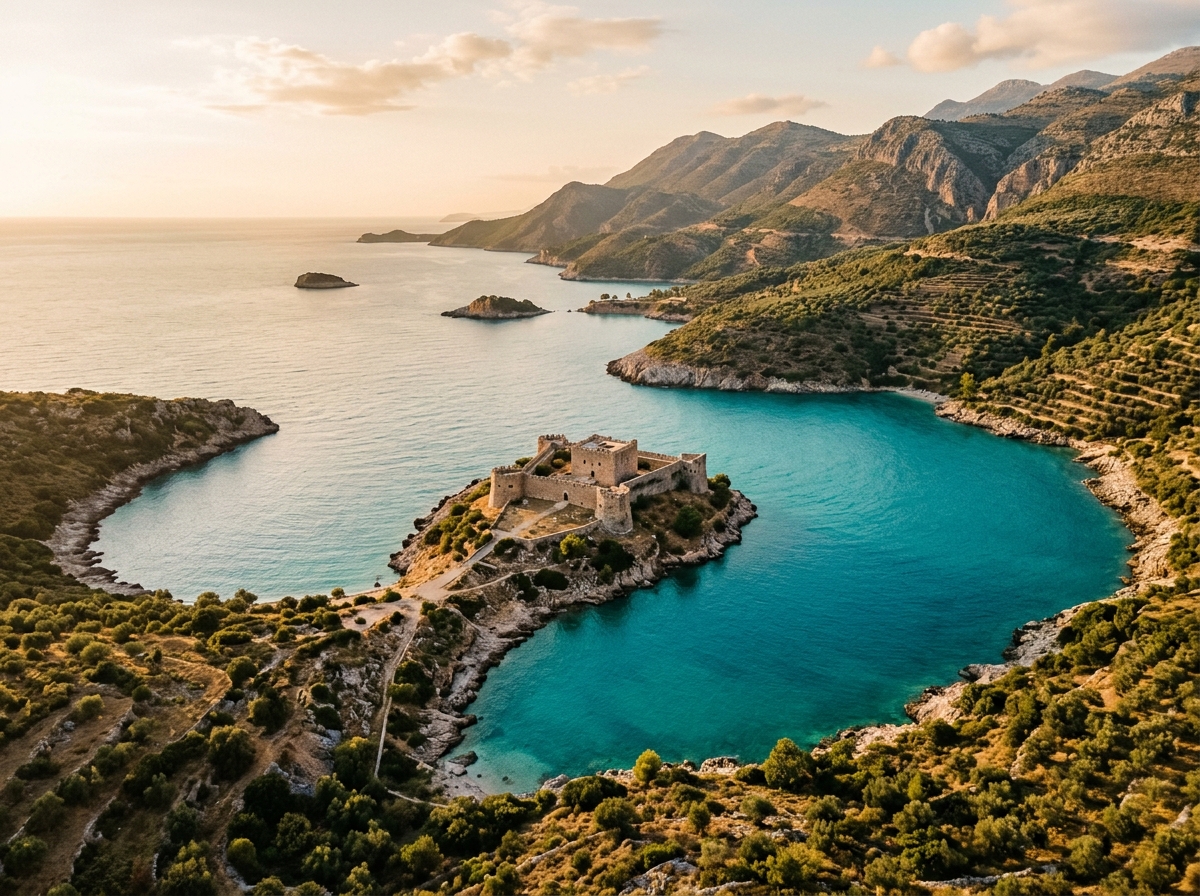
About 12 km south of Himara, the SH8 rounds a headland and suddenly there is a castle sitting at the edge of a circular bay so perfectly shaped it looks artificial. Porto Palermo is a 19th-century Ottoman fortress built by Ali Pasha of Tepelena, and it is the single most photogenic stop on the Riviera.
The castle entry is EUR 2-3. The interior is partially restored, with gun emplacements, vaulted tunnels, and a rooftop platform that gives you a 360-degree view of the bay, the mountains, and the coastline in both directions. The whole visit takes 30 minutes.
Parking is directly on the SH8 (free, pull-off space for 15-20 cars). There is a small beach below the castle that is almost always empty.
The bay at Porto Palermo was used as a submarine base during the communist era, and if you look at the northern shore you can see the concrete bunkers and cave entrances where submarines were hidden. This is a detail you either find fascinating or deeply weird. We find it both.
Borsh: The Long Beach
Borsh Beach is 7 km of uninterrupted coastline — the longest beach in Albania. The northern end is more developed with a few hotels and beach bars. The southern end is essentially empty. The pebbles are larger here than further north, and the water gets deep quickly.
The access road from the SH8 to the beach drops steeply for 2 km. Parking is available at several beach bars (free if you eat/drink, otherwise EUR 1-2).
Borsh is the underrated stop on the Riviera. It lacks the boutique polish of Dhermi and the town infrastructure of Himara, but its scale — that long, unbroken sweep of beach with mountains behind — gives it a feeling of space that the smaller beaches cannot match. If you are staying overnight on the Riviera and want a quiet beach day rather than a scenic drive day, Borsh is the place.
Arriving in Saranda
The final 40 km from Borsh to Saranda follows the coast through increasingly gentle terrain. The mountains step back from the road, the turns become less dramatic, and the road widens as you approach Saranda — the Albanian Riviera’s southern terminus and its largest resort town.
Saranda is built in a horseshoe around a wide bay, with a long promenade, apartment blocks climbing the hillside, and a nightlife scene in summer that runs later than anything further north. The town itself is not particularly charming — it grew too fast and with too little planning — but it is useful as a base for:
- Butrint: The UNESCO archaeological site 18 km south of Saranda. A ruined city spanning Greek, Roman, Byzantine, and Venetian periods. EUR 12 entry, 2-3 hours. Drive there — parking is free.
- Blue Eye (Syri i Kalter): A natural spring 25 km east of Saranda where water of impossible blue color wells up from an underwater cave. EUR 2 entry, 30-minute visit. The access road from the SH99 is paved and easy.
- Ksamil: Small resort town 15 km south, between Saranda and Butrint, with three tiny islands you can swim to from the beach. Crowded in August, pleasant in June and September.
- Corfu ferry: Boats to the Greek island of Corfu run daily from Saranda port (EUR 19-25 one way, 30-45 minutes). You can take a car or go on foot.
Parking in Saranda: Street parking along the waterfront is paid (EUR 0.30-0.50/hour, park-and-pay machines). Free parking is available on side streets uphill from the promenade. The town is compact and walkable once you park.
Road Conditions: The Honest Assessment
The SH8 has improved enormously, but it is not the Croatian D8. Here is what to expect segment by segment:
| Segment | Surface | Width | Guardrails | Difficulty |
|---|---|---|---|---|
| Vlora to Llogara summit | Good asphalt | Narrow (1.5-2 lanes) | Partial | Moderate-challenging (steep, tight turns) |
| Llogara descent to Dhermi | Good asphalt | Narrow | Yes, most sections | Moderate (steep descent) |
| Dhermi to Himara | Good asphalt | 2 lanes mostly | Yes | Easy-moderate |
| Himara to Porto Palermo | Good asphalt | 2 lanes | Yes | Easy |
| Porto Palermo to Borsh | Good asphalt | 2 lanes | Partial | Easy |
| Borsh to Saranda | Good asphalt | 2 lanes | Yes | Easy |
Beach access roads — the side roads from the SH8 down to beaches like Drymades, Gjipe, and Borsh — are often steep, narrow, and unpaved. A standard car handles most of them, but ground clearance helps on the Gjipe track.
Ongoing construction: Albania continuously upgrades the SH8. You may encounter construction zones with temporary detours, flaggers, and gravel stretches. These change from month to month. Accept them as part of the Albanian driving experience.
Fuel Stations
This is important: fuel stations are sparse south of Vlora. Plan accordingly.
| Location | Station available? | Notes |
|---|---|---|
| Vlora | Yes, multiple | Last reliable options before the pass |
| Llogara Pass | No | Nothing on the pass itself |
| Dhermi | Yes, one | Small station, may be out of fuel on busy days |
| Himara | Yes, two | Kastrati and a local station |
| Between Himara and Saranda | One, near Lukova | Small, not always open |
| Saranda | Yes, multiple | Full coverage |
Rule of thumb: Fill up in Vlora and you will have enough fuel for the entire drive to Saranda with plenty of margin. Fill up in Himara if you are making side trips to beaches and the Blue Eye.
Parking at Beaches
Most Riviera beaches have informal parking arrangements:
- Free parking: At some beaches, you park on the roadside or in a dusty lot and nobody charges you.
- Beach bar parking: Park at a beach bar’s lot for free, with the expectation that you will eat or drink there. This is the most common arrangement.
- Paid parking: Dhermi and Saranda have organized paid parking (EUR 1-3/day).
- Roadside: Along the SH8, you can often park at pull-offs above the beach and walk down. Make sure you are not blocking traffic.
Tip: Never leave valuables visible in your car at beach parking. Albania is generally safe, but an unattended car full of bags at a remote beach is a universal temptation. Lock everything in the trunk or take it with you.
Best Time to Drive
| Month | Weather | Crowds | Road conditions | Verdict |
|---|---|---|---|---|
| May | Warm (20-25 C), occasional rain | Very low | Excellent | Excellent — warm enough to swim on good days |
| June | Hot (25-30 C), dry | Low-moderate | Excellent | Best overall month |
| July | Hot (30-35 C), dry | High | Good (more traffic) | Good but busy at beaches |
| August | Very hot (32-38 C), dry | Peak | Good (most traffic) | The Albanian Riviera’s August — busy but functional |
| September | Warm (25-30 C), occasional rain | Moderate | Excellent | Excellent — warm sea, fewer people |
| October | Mild (18-24 C), more rain | Very low | Good | Good for driving, sea may be too cool for swimming |
June and September are the sweet spot. The water is warm enough for swimming, the road traffic is manageable, and the beaches do not require arriving at dawn to find space.
Driving in Both Directions
We have described the drive from Vlora to Saranda (north to south), but the road works equally well in reverse. Two arguments for each direction:
North to south (Vlora to Saranda):
- You climb Llogara Pass in the morning when traffic is lighter
- You stay on the seaward side for better views on right-hand bends
- You arrive in Saranda with access to Blue Eye, Butrint, and Ksamil the next day
South to north (Saranda to Vlora):
- The Llogara descent is replaced by the Llogara ascent, which some drivers find less nerve-wracking (going up feels more controlled than going down)
- Afternoon light hits the north-facing coastline beautifully
- You can continue from Vlora to Berat or Tirana without backtracking
For a multi-day itinerary, consider the Tirana to Berat day trip as a natural inland complement to the Riviera drive. For an honest look at Albanian roads beyond the coast, our road conditions and safety guide covers what to expect across the whole country.
For more on Albania as a driving destination, see our country hub. The Adriatic Coast route from Dubrovnik to Tirana includes the Riviera as part of a longer cross-border itinerary. And our general driving guide covers insurance, documents, and rules for all 9 Balkan countries.