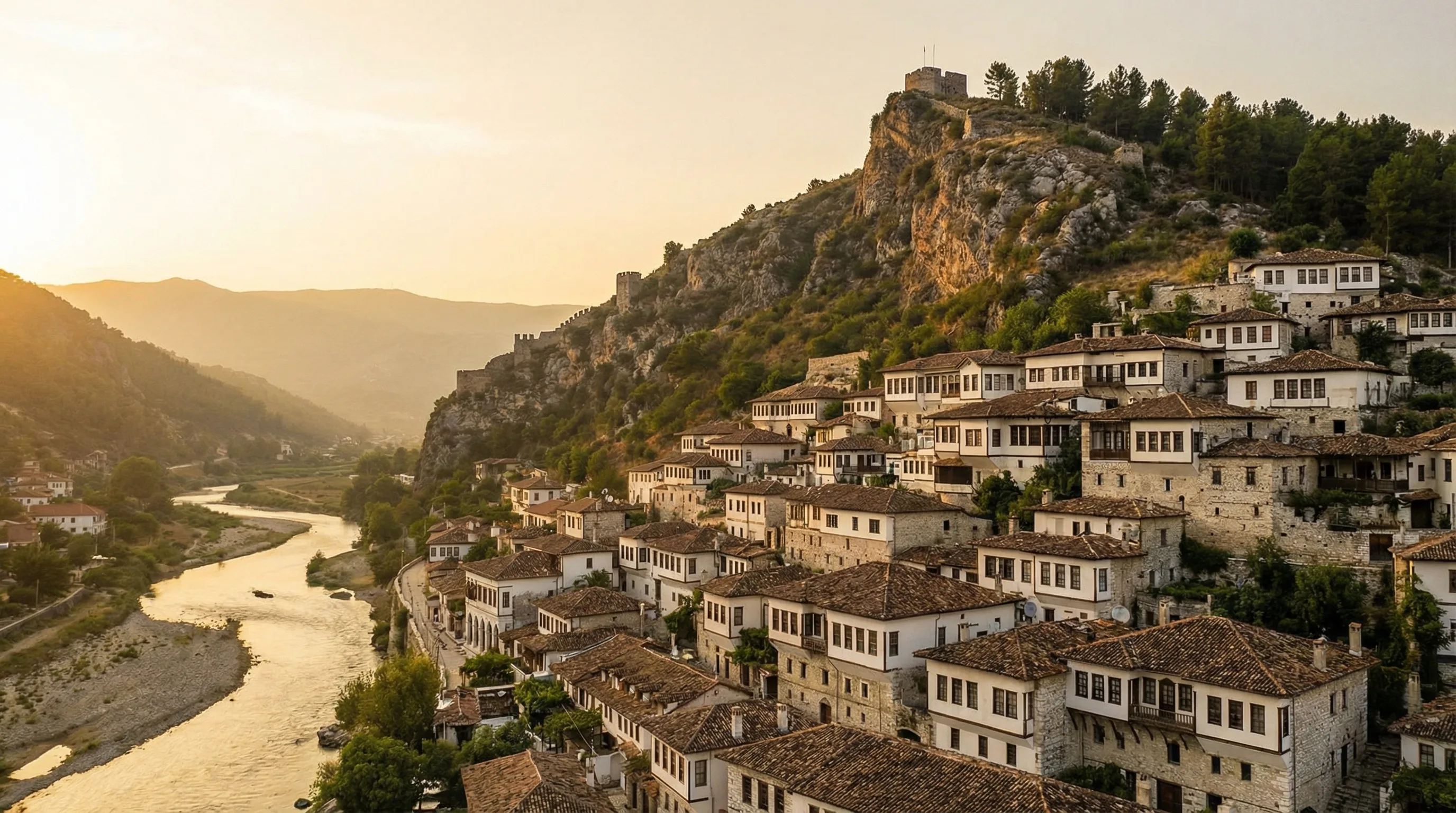
Driving in Albania: Road Conditions, Safety & What No One Tells You
Albania is the most interesting country to drive in the Balkans, and it is also the one that generates the most questions from people planning their first trip. Is it safe? Are the roads passable? Will my rental car survive? Do the police want money? Does Google Maps work? The short answers: yes, mostly yes, probably, no, and sort of. But the short answers miss the texture of what driving in Albania is actually like — the sudden transitions between modern highway and single-track mountain road, the livestock encounters that turn a 5-minute stretch into a 20-minute negotiation, the police checkpoints that are routine but surprising if you have never been stopped before, and the gap between what your GPS says and what the road delivers. This article is the honest assessment we wish we had before our first Albanian road trip.
We have driven in Albania across five separate trips, covering routes from Shkoder to Saranda, Tirana to Theth, the SH8 coast road, the interior toward Lake Ohrid, and the new A2 highway to Kosovo. Our experience is that Albania is perfectly safe to drive for tourists with a reasonable car and reasonable expectations. It is also genuinely different from anywhere else in Europe, and knowing what to expect makes the difference between a great road trip and an anxious one.
Road Quality: The Full Picture
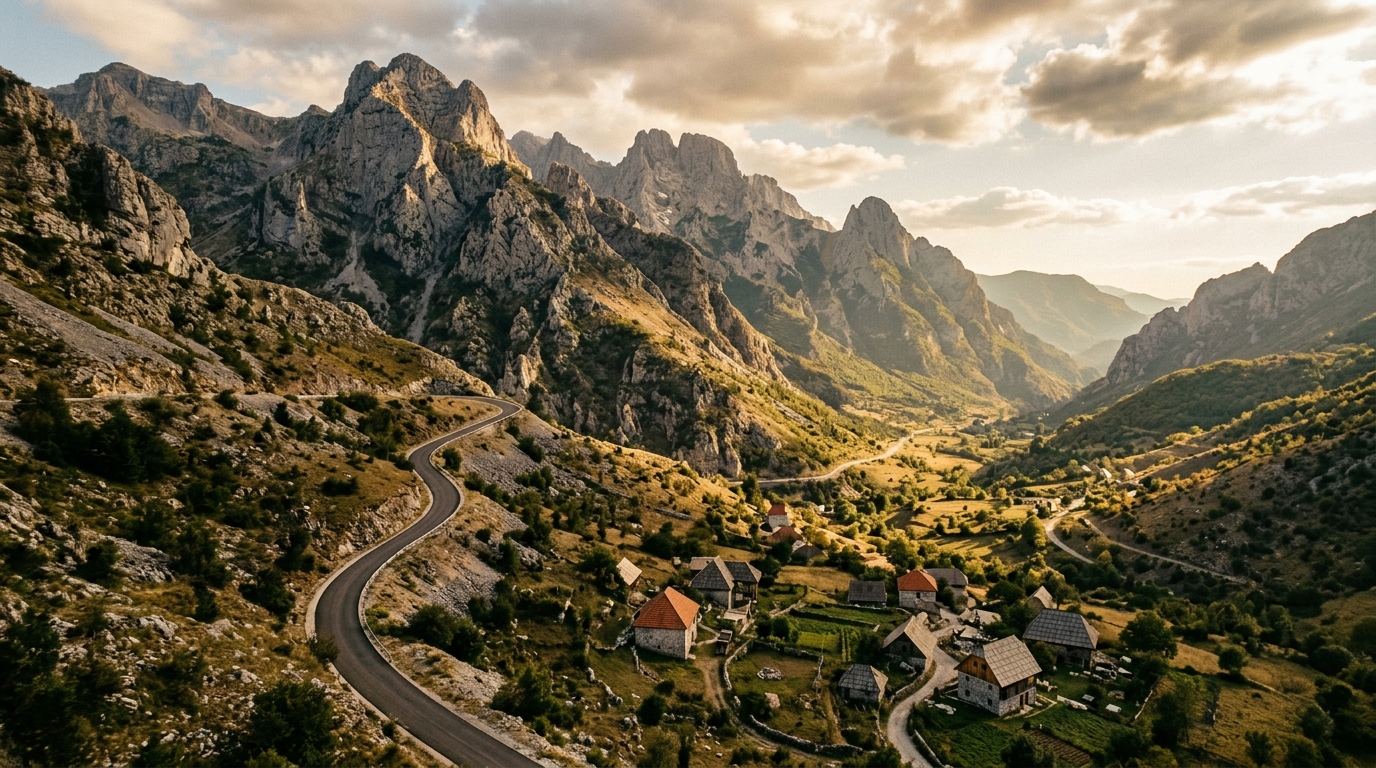
Albania’s road network is improving at a pace that makes old travel blog posts outdated within a year. The country has invested heavily in its main corridors, and several routes that were notorious five years ago are now pleasant drives. But the improvements are concentrated on the main highways, and once you leave them, conditions can change fast.
Main Highways and Corridors
| Road | Route | Condition | Notes |
|---|---|---|---|
| A2 (SH1) | Tirana to Kosovo (Morine) | Excellent | Modern motorway, Albania’s best road |
| A3 | Tirana to Elbasan | Good | Dual carriageway, well-maintained |
| SH4 | Elbasan to Pogradec/Ohrid border | Good | Two-lane, mostly smooth asphalt |
| SH4 | Tirana to Fier (via Lushnje) | Good | Agricultural flat land, easy driving |
| SH8 | Vlora to Saranda (coast) | Good | Upgraded in recent years, see our Riviera guide |
| SH3 | Elbasan to Librazhd to Pogradec | Fair to good | Mountain road, improving |
| Tirana-Durres highway | Tirana to Durres | Good | Albania’s busiest road, 4 lanes |
These roads are the ones you will use for the standard tourist routes — Tirana to Berat, Tirana to the coast, the Albanian Riviera, the route to Ohrid. On these corridors, a standard rental car is perfectly adequate. The asphalt is good, the lanes are clear, and the driving is comparable to rural roads in southern Italy or Greece.
Secondary and Mountain Roads
This is where Albania separates itself from the rest of Europe. The gap between a main highway and a secondary mountain road can be extreme — not just in surface quality, but in every aspect of the driving experience.
| Road | Route | Condition | Notes |
|---|---|---|---|
| Road to Theth | Shkoder to Theth | Fair (mostly paved now) | Narrow, steep, last 15 km challenging |
| Road to Valbona | Bajze to Valbona | Fair | Mountain switchbacks, narrow |
| Permet to Korce | Interior mountain road | Variable | Some unpaved sections |
| Berat to Permet | Through Osum Canyon | Poor to fair | Unpaved sections, high clearance helpful |
| Tepelene to Gjirokaster | SH99 | Good | Recently upgraded |
| Any road marked “white” on the map | Various | Poor to unpaved | Assume gravel or worse |
The rule of thumb: If the road has an SH (Shteg Nacional) designation, it is likely paved and driveable in a normal car. If it does not, check recent reports before attempting it. The transition from “paved road” to “gravel track shared with cows” can happen in under a kilometer.
What “Variable” Actually Means
When we say road conditions are “variable” in Albania, we mean you might encounter any of the following on a single 50 km stretch:
- Fresh, smooth asphalt with painted lane markings
- Asphalt with potholes that require swerving
- A section under construction with no warning signs, just a guy waving a flag
- Gravel or dirt for 500 meters where a bridge is being rebuilt
- A completely normal two-lane road that suddenly narrows to one lane because half of it fell into a river
- A flock of sheep occupying the entire road width, guided by a shepherd who will not hurry
This is not dangerous. It is just different. The key is to drive at a speed that lets you react to whatever the road produces next. In Albania, that speed is lower than you think.
Tip: When you see a freshly paved section of road in Albania, enjoy it — and pay extra attention immediately after it ends. The transition from new surface to old surface can be abrupt, with a sudden drop in road level or unexpected gravel.
Google Maps vs Reality
Google Maps works in Albania. The map data is accurate. The routing is generally correct. The estimated drive times are fiction.
Google Maps calculates drive times based on speed limits and road classification. In Albania, these inputs do not capture the reality of the road. A road classified as a “secondary highway” might be a well-paved two-lane road or a narrow mountain track. The speed limit might say 80 km/h, but the actual safe speed is 40 km/h because of blind corners, livestock, construction, and the general character of the road.
Real Drive Times vs Google Maps
| Route | Google Maps estimate | Actual drive time | Why |
|---|---|---|---|
| Tirana to Berat | 1h 40min | 2h - 2h 15min | Town speed limits, traffic near Tirana |
| Tirana to Saranda | 4h 30min | 5h 30min - 6h | Mountain sections, Llogara Pass |
| Shkoder to Theth | 2h 30min | 3h 30min - 4h | Mountain road, narrow sections |
| Saranda to Gjirokaster | 1h | 1h 15min | Accurate for this road |
| Vlora to Saranda (SH8) | 2h 30min | 3h 30min - 4h | Llogara Pass, stops inevitable |
| Tirana to Ohrid border | 2h 30min | 3h - 3h 30min | Mountain road after Pogradec |
The correction factor: Add 30-50% to Google Maps estimates for any route that involves mountain roads, passes through multiple towns, or goes anywhere south of Elbasan. For the main corridor from Tirana to Durres or the A2 to Kosovo, Google Maps is roughly accurate.
We have a running joke that Google Maps in Albania displays the time it would take if the road existed in Germany. The Albanian version of that road requires an adjustment for altitude, livestock, construction, and the philosophical question of whether the road still continues around that next bend.
Livestock on Roads
This deserves its own section because it happens on every trip and surprises every first-time driver.
Albanian roads — even main roads, even highways — share space with livestock. Sheep, goats, cattle, horses, and donkeys use the road for the same reason you do: it is the flattest, most direct path between two points. Shepherds guide their flocks along the roadside and sometimes across the road, and individual animals wander onto the asphalt without any human supervision.
How to handle it:
- Slow down. If you see one animal, expect more. Flocks move as a group, and the stragglers often dart across the road after the main group has passed.
- Do not honk aggressively. A light tap on the horn warns the animals and the shepherd. Aggressive honking can scatter the flock in unpredictable directions, which makes the situation worse.
- Wait. A flock crossing the road takes 2-5 minutes. This is Albania. The schedule will survive.
- Watch for solitary animals. A lone cow standing in the road at a bend is more dangerous than a flock with a shepherd. The cow does not know you are coming, and it will not move until it decides to.
Livestock encounters are most common on mountain roads, on the SH8 coastal road, and near any village. They are least common on the A2 motorway (which is fenced) and the Tirana-Durres highway.
Police Checkpoints
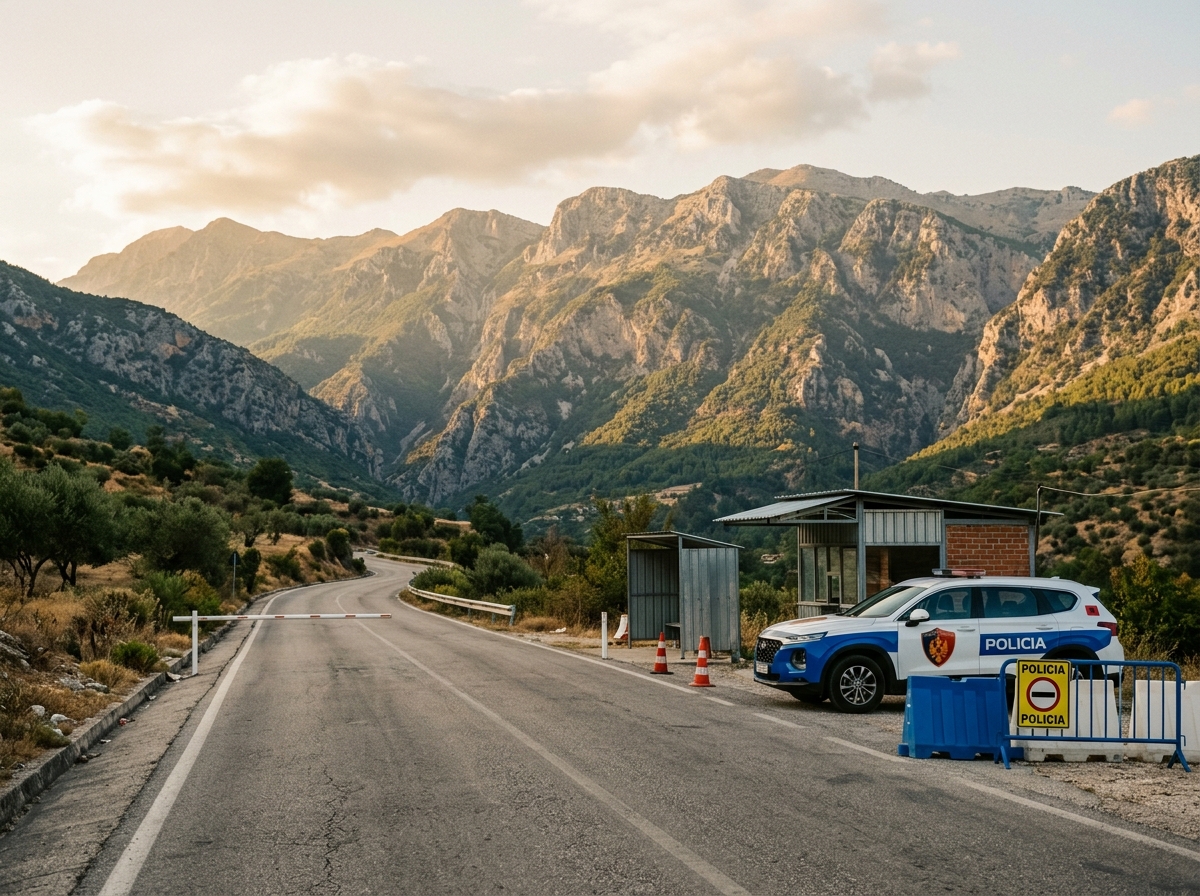
Albanian police operate visible checkpoints on main roads, especially on the approaches to cities and at major intersections. These are routine — they are checking documents, not targeting tourists.
What Happens at a Checkpoint
- A police officer signals you to pull over (sometimes all traffic, sometimes selected vehicles)
- The officer approaches your window and asks for documents
- You hand over: driving licence, vehicle registration, rental agreement, insurance (green card or Albanian insurance certificate)
- The officer reviews the documents (30 seconds to 2 minutes)
- If everything is in order, they hand the documents back and wave you on
- Total time: 2-5 minutes
What They Want to See
| Document | Details |
|---|---|
| Driving licence | EU licence accepted; IDP recommended but not legally required for EU citizens |
| Vehicle registration | For rental cars: the rental agreement acts as registration proof |
| Insurance proof | Green card (with Albania listed) or Albanian insurance bought at border |
| Passport/ID | Occasionally, not always |
The Bribe Question
We address this directly because it is the most common concern people have about Albanian police. In our experience across five trips, we have never been asked for a bribe by an Albanian police officer. The checkpoints are routine, the officers are professional, and the interaction is bureaucratic rather than predatory.
If you are issued a fine (for speeding, improper documents, etc.), the officer will write a receipt. This is the official process. Albanian fines are payable at a bank or post office. If someone asks for cash without a receipt, politely ask for written documentation. The request usually resolves itself.
Albanian police have modernized considerably. Body cameras are increasingly common, and the traffic police (Policia Rrugore) operate under scrutiny that discourages the informal practices of 15 years ago. Drive legally, carry your documents, and the police checkpoints are a 3-minute pause, not a problem.
Tip: Keep all your documents in one place — a folder or envelope on the passenger seat. When the officer asks for documents, handing over a neat set of papers quickly and calmly signals that you know the drill. Fumbling through the glove box while the officer waits creates unnecessary tension.
Night Driving
We do not recommend driving at night outside Albanian cities. This is not about safety from crime — it is about road conditions and visibility.
Why night driving is risky:
- No street lighting. Outside cities and towns, Albanian roads are unlit. Even main highways have no illumination. Your headlights are all you have.
- Unmarked hazards. Potholes, construction zones, and road damage that you can see and avoid in daylight become invisible at night.
- Livestock. Animals do not leave the road after dark. A dark-colored cow standing on a dark road is nearly invisible until your headlights catch it at close range.
- Other drivers. Some Albanian vehicles have poor lighting — dim headlights, no taillights, no reflectors. This includes agricultural vehicles, which are slow and hard to see.
- Pedestrians. In rural areas, people walk along the road at night, often in dark clothing. The absence of sidewalks means they share the road with cars.
When night driving is acceptable:
- Tirana city driving (streets are lit)
- The Tirana-Durres highway (well-lit, fenced)
- Short stretches on main roads near cities (Shkoder, Vlora, Saranda)
When to avoid it:
- Mountain roads (all of them, no exceptions)
- The SH8 coastal road
- Any rural or secondary road
- The road to Theth or Valbona
Plan your driving so you arrive at your destination before dark. In summer, that gives you until about 8:30 PM. In winter, you need to be off mountain roads by 5 PM.
Fuel Stations
Albania has adequate fuel coverage on main routes and in cities, but gaps exist in mountainous and rural areas.
Major Chains
| Chain | Coverage | Payment | Quality |
|---|---|---|---|
| Kastrati | Nationwide, largest network | Cash and card | Good |
| Europetrol | Major cities and highways | Cash and card | Good |
| Alpet | Major cities | Cash and card | Good |
| A1 | Tirana area, some highways | Cash and card | Good |
| Local independent stations | Rural areas | Cash only | Variable |
Prices: Fuel in Albania costs approximately EUR 1.40-1.50 per liter for petrol (Eurosuper 95) and EUR 1.30-1.45 for diesel. Prices are comparable to neighboring countries and slightly cheaper than Croatia.
Where Fuel Gets Scarce
| Route | Last reliable station | Next station | Gap |
|---|---|---|---|
| Shkoder to Theth | Shkoder city | Theth (none) | Fill up before leaving |
| Vlora to Saranda (SH8) | Vlora | Himara (small) | 70 km |
| Berat to Permet | Berat | Permet | 70 km, no reliable options |
| Korce to Erseke | Korce | Erseke (small) | 50 km |
| Lake Koman ferry route | Shkoder | Fierze (small) | Fill up in Shkoder |
Rule: If you are heading to mountains, Albanian Alps, or any route marked as “remote” in this guide, fill your tank before you leave the nearest city. Running out of fuel on a mountain road in Albania is not an adventure — it is a very long walk.
Insurance
Insurance is the most important practical detail for driving in Albania, and the one that catches most people.
If You Are Driving a Rental Car
- Confirm with your rental agency that Albania is listed on the insurance policy. Many Croatian and Montenegrin agencies do not cover Albania.
- If your rental agency covers Albania, you should have a green card that includes “AL” (not crossed out) on the back. Carry this in the car.
- If your rental does not cover Albania, you can buy Albanian third-party insurance at the border. Cost: EUR 15-30 for 15 days. This is legal and accepted at police checkpoints.
If You Are Driving Your Own Car
- Your European insurance green card should list Albania. If “AL” is crossed out on the back, contact your insurer before the trip to add Albanian coverage.
- If your insurer cannot add Albania, buy border insurance (same EUR 15-30 for 15 days).
What Police Check
At police checkpoints, officers may ask for your insurance proof. “May” is the key word — not every checkpoint asks, but enough do that you should always have the document ready. If you cannot produce proof of insurance and are asked, the fine is significant, and your car can theoretically be impounded. In practice, they will likely let you buy insurance at the nearest town, but the fine still applies.
Speed Limits and Enforcement
| Zone | Speed limit |
|---|---|
| Urban areas | 40 km/h |
| Rural roads | 80 km/h |
| Main roads / expressways | 90 km/h |
| Motorways (A2, A3) | 110 km/h |
The 40 km/h urban limit is the one that catches foreign drivers. Every other Balkan country uses 50 km/h in towns. Albania uses 40 km/h. Speed cameras exist at the entrances to many towns along main routes (the SH4, the Tirana-Durres road, the approach to Shkoder), and they issue fines that get sent to rental agencies.
Enforcement is concentrated on main roads and city approaches. On mountain roads, enforcement is minimal — but on mountain roads, exceeding the speed limit is a self-correcting problem.
Driving Culture
Albanian driving culture is more Mediterranean than Central European. It is assertive, flexible with rules, and involves more horn-use than you may be comfortable with. Some observations:
- Horn use is communication, not aggression. A honk means “I’m here” or “I’m coming through” or “the light changed two seconds ago.” It is not road rage. When you are around a blind mountain corner, honk. When a pedestrian steps into the road, honk. When the car ahead is dawdling, everyone honks.
- Overtaking is creative. Albanian drivers will overtake in places that would make a German driving instructor faint. As a tourist, you do not need to match this behavior. Drive at your own pace, stay right, and let them pass you. You will arrive at your destination at approximately the same time.
- Roundabouts are anarchic. In Tirana especially, roundabout behavior follows a principle best described as “confidence wins.” The car that enters most assertively gets the right of way. This contradicts every official rule but accurately describes reality. Be assertive but not reckless.
- Lane discipline is relaxed. On multi-lane roads (Tirana, the Tirana-Durres highway), lane changes happen without signaling, and the concept of “fast lane vs slow lane” is loosely interpreted.
Tip: The most dangerous thing you can do in Albanian traffic is hesitate. If you are entering a roundabout, merging into traffic, or turning left across a road — commit to the action. Albanian drivers expect other drivers to be decisive. A hesitant car in a roundabout creates confusion.
Safety: The Honest Assessment
Is Albania safe to drive? Yes. With qualifications.
Crime: Essentially a non-issue for tourists driving through Albania. Car theft, carjacking, and road-related crime are extremely rare along tourist routes. Albania is one of the safest countries in Europe for personal safety, and the police presence (frequent checkpoints) reinforces this.
Road safety: The real risk in Albania is the road itself, not other people. The combination of variable road conditions, livestock, night driving challenges, and mountain terrain means you need to drive with attention. Albania’s traffic fatality rate is higher than Western Europe’s, primarily due to speed, road conditions, and older vehicles. As a tourist driving a modern rental car at moderate speeds during daylight, your risk is manageable.
Breakdowns: If your car breaks down on a main road, help arrives faster than you might expect. Albanian drivers routinely stop to help stranded vehicles. Towing services exist in all major cities (Tirana, Shkoder, Vlora, Saranda, Korce), and your rental agency should have a roadside assistance number. On mountain roads, you may need to wait longer. Carry a phone with a charged battery and the rental agency’s emergency number saved.
Emergency numbers:
- Police: 129
- Ambulance: 127
- Fire: 128
- General emergency: 112
Practical Summary
| Factor | Assessment | Details |
|---|---|---|
| Main road quality | Good | SH-designated roads are mostly well-paved |
| Mountain road quality | Variable | Can be unpaved, narrow, no guardrails |
| Safety from crime | Very safe | Not a concern for tourists |
| Police checkpoints | Routine | Documents check, 3-5 minutes, professional |
| Livestock | Expect it | Slow down, especially near villages and on mountain roads |
| Google Maps accuracy | Timing is off | Add 30-50% to mountain/rural estimates |
| Night driving | Avoid outside cities | No lighting, animals, hazards |
| Fuel availability | Good on main roads | Sparse in mountains — fill up in cities |
| Insurance | Essential | Green card or border insurance, carry it always |
| Speed cameras | Present | Town entrances on main roads, 40 km/h urban limit |
The Bottom Line
Driving in Albania is not difficult. It is different. The roads require more attention than Croatia or Montenegro. The GPS requires more skepticism. The pace requires more patience. But the rewards — coastline that rivals Greece at a fraction of the cost, mountain scenery that belongs in a different century, towns like Berat that UNESCO got right, and a coast road that makes you understand why driving was invented — are worth every minute of extra concentration behind the wheel.
Bring your documents, fill your tank, drive during daylight, add time to your GPS estimates, and stay patient with the sheep. Albania will take care of the rest.
For the country overview including fuel prices, speed limits, and border crossings, see our Albania hub. For the coast road experience, our Albanian Riviera driving guide has the detailed breakdown. And for the full cross-border picture, the driving guide covers all 9 Balkan countries, with the car rental guide handling the insurance and booking details.