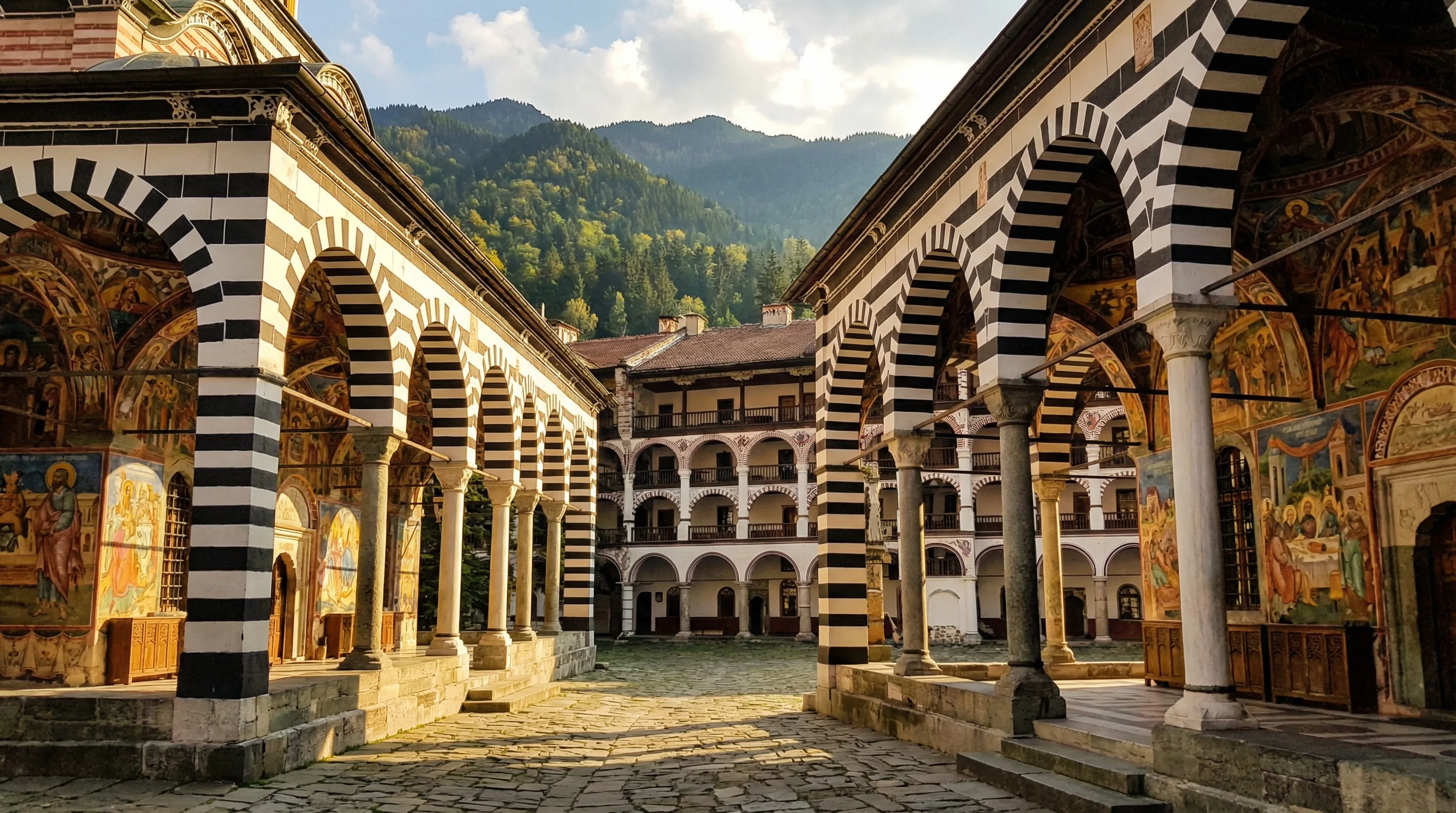
Sofia to Black Sea Drive
Crossing Bulgaria west to east is one of those drives that can be as simple or as rich as you choose to make it. The motorway route – Trakia motorway, flat and fast – gets you from Sofia to the Black Sea in under five hours with no engagement whatsoever. The scenic route, threading through Plovdiv’s old town, the Kazanlak Rose Valley, and over the Shipka Pass through the Balkan Mountains, takes twice as long and is worth ten times as much. We have done both. We recommend the scenic route to anyone who considers driving a means of discovery rather than a necessary evil between airports.
The distance is roughly 400 km regardless of which route you choose. The difference is in what you see along the way and, frankly, in who you are as a traveler when you arrive at the coast. The motorway delivers you efficiently. The scenic route delivers you informed.
Two Routes Compared
| Trakia Motorway (Fast) | Scenic Route (via Plovdiv + Shipka) | |
|---|---|---|
| Distance to Burgas | 380 km | 420 km |
| Distance to Varna | 440 km | 460 km (via Kazanlak, then north) |
| Drive time (no stops) | 4-5 hours | 7-8 hours |
| Recommended time | 1 day | 2-3 days |
| Tolls | Vignette required (BGN 30 / ~EUR 15 for 7 days) | Same vignette covers this route |
| Character | Flat, straight, efficient, boring | Mountains, history, wine, roses |
| Best for | Getting there | Being there |
You need a Bulgarian vignette for both routes. Buy it at the border (available at gas stations near every crossing), online at bgtoll.bg, or at gas stations inside Bulgaria. Driving without a vignette risks a BGN 300 (~EUR 150) fine.
The Fast Route: Trakia Motorway
If you genuinely need to reach the coast in a day from Sofia, the Trakia motorway (A1) runs east through Plovdiv, then continues to a junction where you choose Burgas (south fork, A1) or Varna (north fork via the A2/Maritsa motorway and then the A3).
The road is modern, well-maintained, and featureless – Thracian plains, sunflower fields, occasional truck stops. Speed limit is 140 km/h (one of the highest motorway limits in Europe), and Bulgarians treat it as advisory. Rest areas with fuel and food appear every 40-60 km.
Even on the fast route, we strongly recommend a Plovdiv stop. The motorway passes directly through the city, and a 2-3 hour detour into the old town transforms a transit drive into something memorable.
The Scenic Route: Sofia to Plovdiv
| Distance: 150 km | Drive time: 1.5-2 hours via A1 |
Start on the Trakia motorway east from Sofia. The first 150 km to Plovdiv is motorway – flat, fast, and necessary. The scenic portion begins at Plovdiv.
Plovdiv
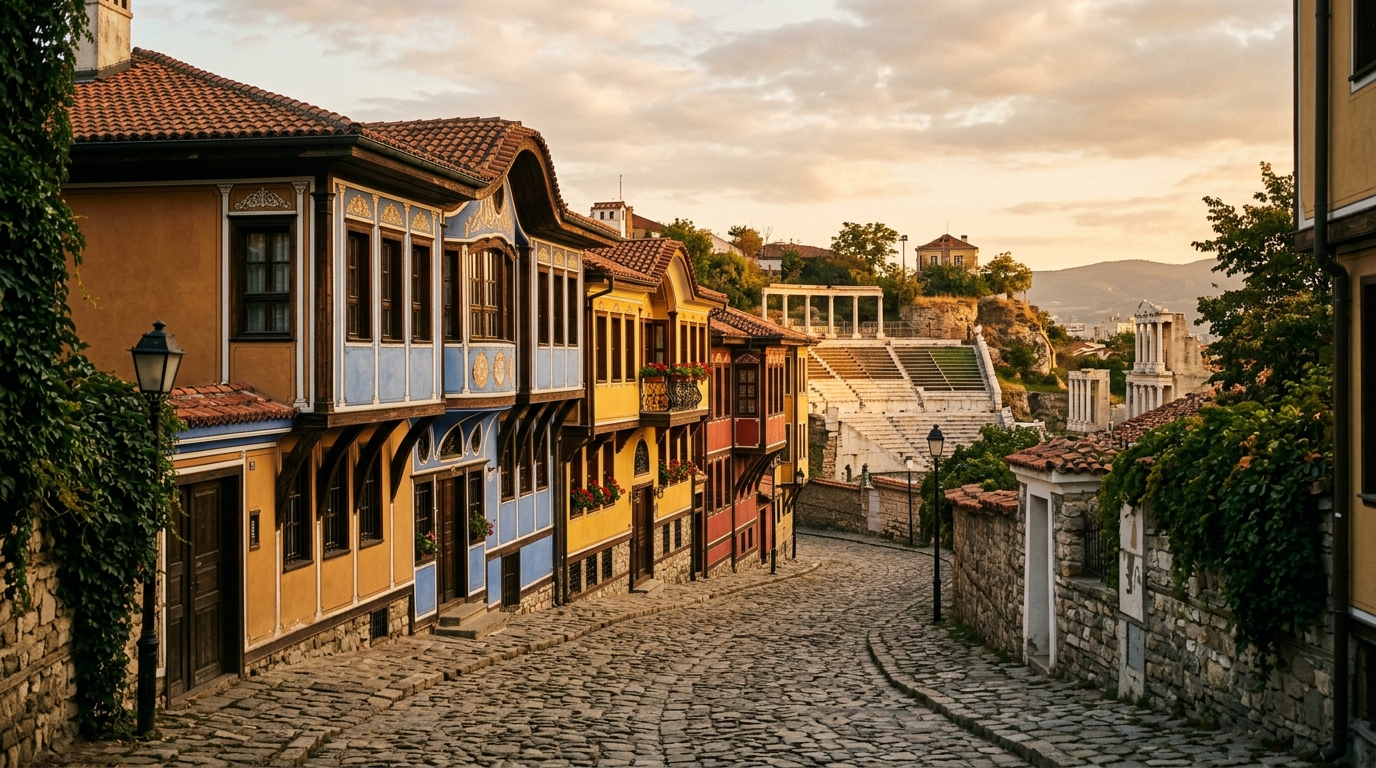
Plovdiv is Bulgaria’s second city and arguably its most interesting. It is one of the oldest continuously inhabited cities in Europe (the Thracians were here around 4000 BC), and the layers of history are visible in a single walk: Roman stadium under the main pedestrian street, Ottoman mosques beside Bulgarian Revival houses, and the ancient theatre of Philippopolis (2nd century AD, still hosting performances) carved into the hillside.
Do not skip Plovdiv. If you skip every other stop on this route, spend your time here. Two hours is the minimum for the Old Town; half a day is better.
| Plovdiv Highlights | Time | Cost |
|---|---|---|
| Old Town walk (Revival houses, cobblestones) | 1-2 hours | Free |
| Roman Theatre of Philippopolis | 30 min | BGN 5 (~EUR 2.50) |
| Roman Stadium (under pedestrian street) | 15 min | Free (visible from above) |
| Kapana creative district (lunch, coffee) | 1 hour | Varies |
| Regional Ethnographic Museum | 45 min | BGN 5 (~EUR 2.50) |
Parking: The Old Town is on a hill with narrow streets – park in the lots below (along Boulevard Tsar Boris III, BGN 2/hour) and walk up. The climb is short and the view from the top justifies the effort.
Lunch in Plovdiv: Kapana (The Trap) is a district of narrow streets below the Old Town that has been converted into a zone of restaurants, bars, and small shops. Pavaj and Rahat Tepe are good lunch options. Budget BGN 20-30 (EUR 10-15) per person for a full meal with wine.
Tip: Plovdiv was European Capital of Culture in 2019, and the investment shows. The city has a polish and energy that Sofia sometimes lacks, and the restaurant scene is genuinely exciting. If you have to choose between spending an extra night in Sofia or in Plovdiv, choose Plovdiv.
Plovdiv to Kazanlak: The Rose Valley
| Distance: 100 km | Drive time: 1.5 hours via DN6 |
From Plovdiv, head east on the DN6 (old main road, not the motorway) toward Karlovo and Kazanlak. The road runs through the Valley of Roses – a stretch between the Balkan Mountains to the north and the Sredna Gora range to the south where Bulgaria produces roughly 85% of the world’s rose oil.
The rose fields bloom in late May and early June. If your timing coincides, the valley is a patchwork of pink and the air is heavy with fragrance. Outside bloom season, the valley is agricultural and pleasant without being spectacular. The Rose Festival in Kazanlak (first weekend of June) includes harvest demonstrations, parades, and enough rose-themed products to stock a small pharmacy.
Kazanlak
Kazanlak is the rose oil capital and the gateway to the Thracian tombs. The Thracian Tomb of Kazanlak (4th century BC, UNESCO World Heritage Site) is the headline attraction – a burial chamber with remarkably preserved frescoes depicting a funeral feast. The original is accessible only by special arrangement; the replica next door is excellent and open to all.
| Kazanlak Stops | Time | Cost |
|---|---|---|
| Thracian Tomb (replica) | 30 min | BGN 6 (~EUR 3) |
| Museum of Roses | 45 min | BGN 8 (~EUR 4) |
| Kulata Ethnographic Complex | 30 min | BGN 4 (~EUR 2) |
The Museum of Roses explains the rose oil distillation process in more detail than you expect to find interesting, and then it is.
Shipka Pass
| Distance from Kazanlak: 15 km to the pass | Drive time: 30 minutes |
The Shipka Pass (1,185 meters) crosses the Balkan Mountains north of Kazanlak and is one of the most historically significant mountain passes in Bulgaria. In 1877, during the Russo-Turkish War, Bulgarian and Russian forces defended the pass against repeated Ottoman attacks in a battle that became a defining moment of Bulgarian national identity.
The road up to the pass is a series of well-maintained switchbacks through beech forest. At the summit, the Shipka Monument (Freedom Monument) stands on the peak – a stone tower you can climb (282 steps) for views across the Rose Valley to the south and the Thracian Plain to the north.
| Shipka Pass Details | |
|---|---|
| Altitude | 1,185 m |
| Monument entry | BGN 4 (~EUR 2) |
| Climbing the monument | 282 steps, 15-20 min |
| Parking | Free lot at the base of the monument steps |
Midway up the pass, the Shipka Memorial Church (Russian-style, gold domes, built with donations from Russia after the war) is a photogenic 15-minute stop. Entry is free.
Tip: The Shipka Pass road is open year-round but can be snowy and icy from December through March. The summer drive is straightforward in any car. The views from the monument are best in the morning when the haze has not yet settled over the valley.
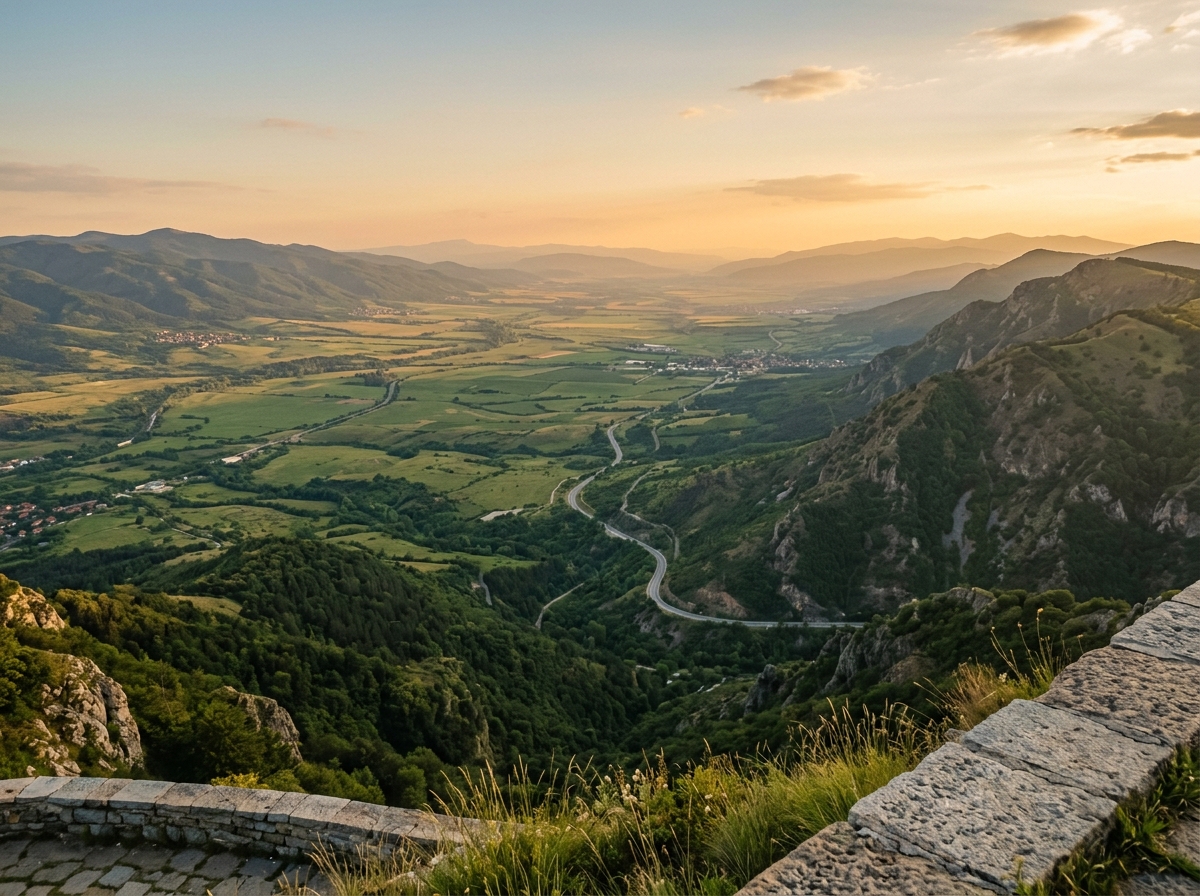
Shipka to the Black Sea
After crossing the Shipka Pass, you descend into the Thracian Plain and head east toward the coast. From here, you choose your destination:
Option 1: Varna (City Beach)
| Distance from Shipka: ~250 km | Drive time: 3-3.5 hours |
Take the road northeast through Gabrovo and Veliko Tarnovo (Bulgaria’s medieval capital, worth a stop if time allows – the Tsarevets Fortress on the hilltop is impressive), then join the A2 motorway east to Varna.
Varna is Bulgaria’s third-largest city and the main port on the Black Sea coast. It has a long beach promenade, a Roman-era thermae (public baths), an excellent archaeological museum, and a genuine urban energy that the resort towns lack. Varna works as a base for exploring the northern Black Sea coast.
Option 2: Burgas (Beach Base)
| Distance from Shipka: ~220 km | Drive time: 3 hours |
Head east from Shipka toward Sliven, then southeast on the A1 motorway to Burgas. This is the more direct route to the southern Black Sea coast, where the beaches are sandier and the resort infrastructure is more developed.
Burgas itself is a working city with a pleasant sea garden (park along the coast) and reasonable restaurants. It serves better as a base than as a destination – use it to access the beaches to the south (Sozopol, Primorsko) or the old town of Nessebar to the north.
Option 3: Nessebar (Old Town)
| Distance from Shipka: ~230 km | Drive time: 3 hours |
Nessebar is a UNESCO-listed old town on a small peninsula connected to the mainland by a causeway. The old town has medieval churches (some in ruins, some intact), cobblestone streets, and the characteristic wooden-upper-story houses of Black Sea architecture. It is touristy in summer but genuinely beautiful, and small enough to walk in an hour.
| Coastal Destination | Character | Beach Quality | Tourist Level |
|---|---|---|---|
| Varna | City, cultural, urban beach | Good (wide, sandy) | Moderate |
| Burgas | Practical base, sea garden | Good (sandy, clean) | Low-moderate |
| Nessebar | Historic old town, crowded | Rocky in old town, sandy nearby | High in summer |
| Sozopol | Artistic old town, quieter | Very good (sandy) | Moderate |
Practical Information
Fuel
Fuel stations are frequent along the entire route. Petrol costs roughly BGN 2.80/L (~EUR 1.43), diesel BGN 2.75/L (~EUR 1.40). Shell, OMV, and Lukoil are the main chains. Credit cards accepted everywhere on main routes.
Road Conditions
- A1 Trakia Motorway: Excellent, modern highway. Speed limit 140 km/h.
- DN6 through Rose Valley: Two-lane, good condition, moderate traffic.
- Shipka Pass road: Well-maintained switchbacks, manageable in any car. Can be slow behind trucks.
- Roads to the coast: Mix of motorway and two-lane national roads. Condition generally good.
Vignette
Bulgarian vignette is mandatory for all motorways and national roads. Available in 1-day (BGN 8 / ~EUR 4), 7-day (BGN 30 / ~EUR 15), and 30-day (BGN 54 / ~EUR 28) periods. Buy online at bgtoll.bg or at border gas stations. Camera enforcement is active.
Best Time
- Late May-June: Rose harvest, comfortable temperatures, pre-summer crowds.
- July-August: Hot (35+ degrees), Black Sea resorts crowded, beaches busy. The inland route is less affected.
- September: Warm seas, thinner crowds, grape harvest. Excellent.
- October: Comfortable driving weather, autumn color on Shipka Pass, coast quieting down.
Combining with Other Routes
- Rila Monastery: Day trip from Sofia before starting this east-west crossing.
- From Romania: Cross at Ruse-Giurgiu and drive south to Shipka, then east to the coast.
- From Serbia: Cross at Gradina-Kalotina (E80) into Sofia, then follow this route east.
- To Greece: From Plovdiv, head south to the Greek border at Kulata (180 km, 2.5 hours).
For Bulgaria vignette details, speed cameras, and insurance rules, see our Bulgaria hub page and the driving guide.